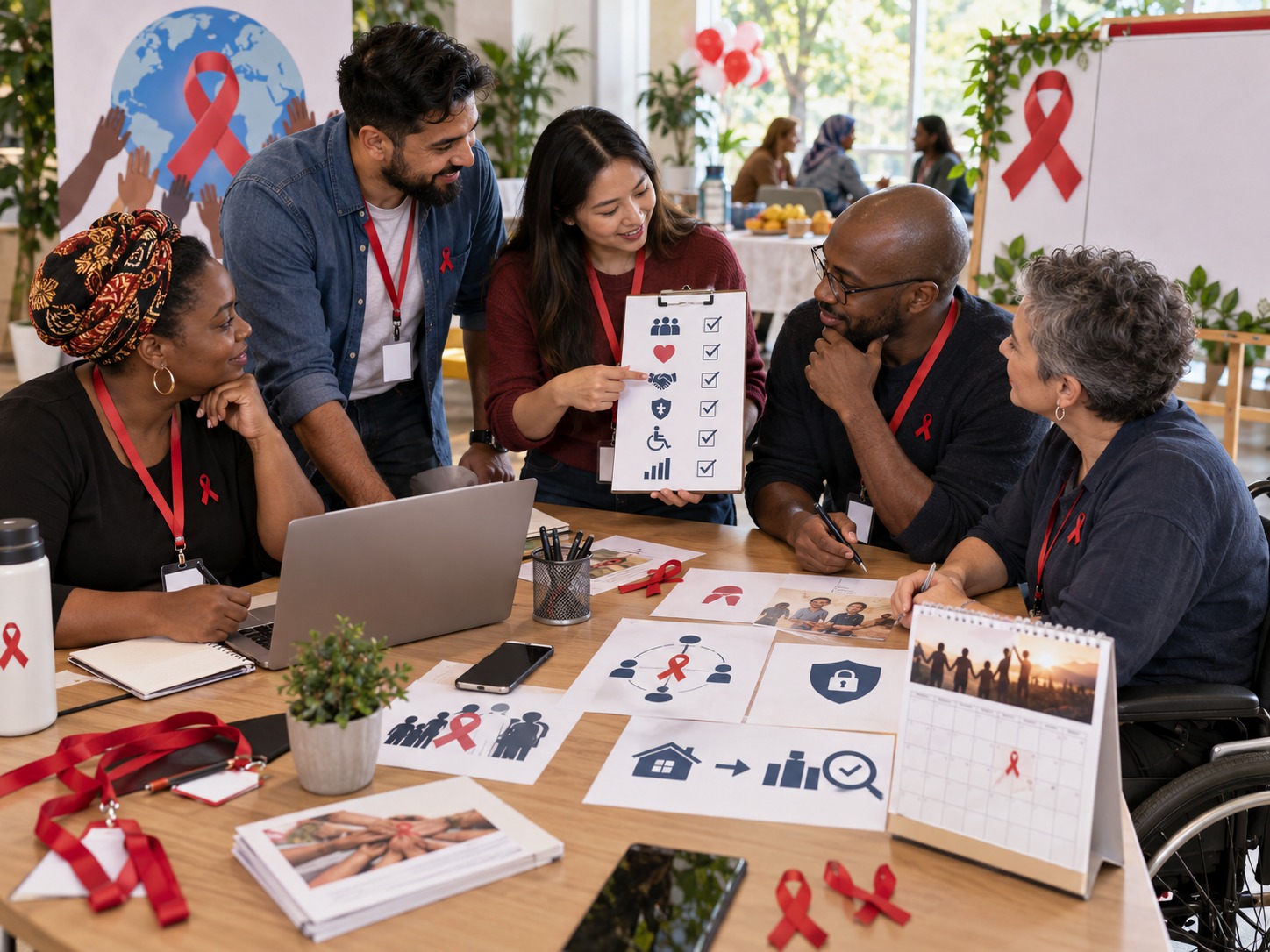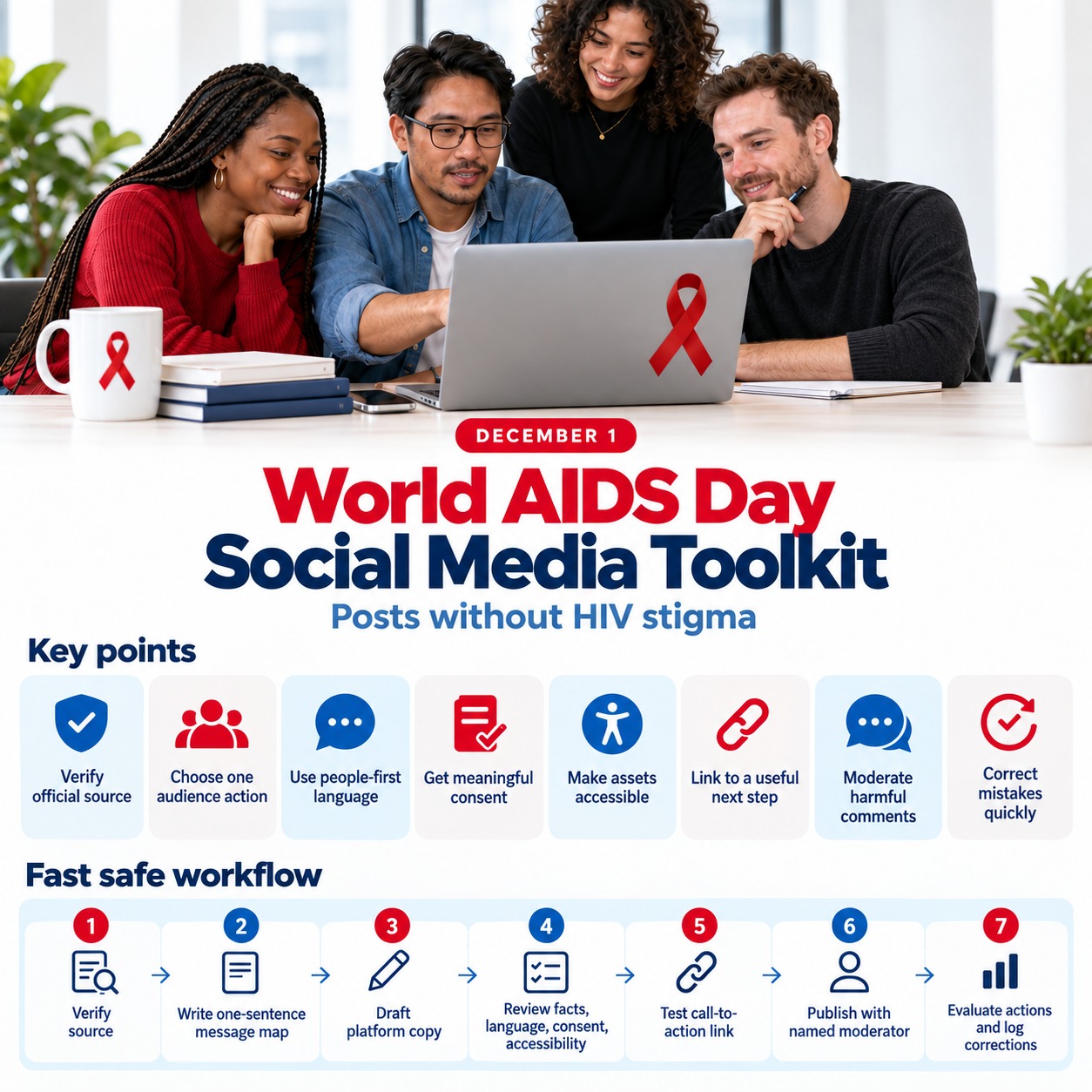
A practical World AIDS Day social media toolkit needs more than ready-made captions. It should help a team choose one audience action, verify every claim, use people-first language, obtain meaningful consent for stories and images, make assets accessible, link to a useful next step, moderate harmful comments and correct mistakes after publication.
The fastest safe workflow is:
- verify the current official World AIDS Day source;
- write a one-sentence message map;
- draft platform-specific copy from that map;
- complete fact, language, consent and accessibility reviews;
- test the call-to-action link;
- publish with a named moderator;
- evaluate actions and log corrections.
Start with a message map, not a caption
Before opening a design tool, complete these five lines:
- Audience: Who specifically needs this message?
- Barrier: What prevents the desired action now?
- One message: What is the single most useful idea?
- One action: What should the person do next?
- Proof and destination: Which current source supports the claim, and where does the link go?
For example, the audience might be people in Thailand who want a private HIV test but do not know where to begin. The barrier is fear of judgment and uncertainty about locations. The message is that testing is a routine health action, and the action is to compare service locations and contact a clinic.
If a draft needs three messages and four calls to action, split it into a short series. One focused post is easier to understand, review and measure.
Verify the theme and assets for the current year
The WHO World AIDS Day page confirms the 1 December observance and links annual campaign pages. Before using a theme, statistic, logo or graphic:
- confirm the year and publication owner;
- read the asset-use and credit instructions;
- save the source URL and review date;
- check whether a translated phrase preserves the intended meaning;
- recheck immediately before scheduling.
If the theme for the upcoming observance has not been published, use a placeholder in the production calendar. Do not guess the theme or present a previous year's message as current. For an example of how an earlier annual theme was presented, see Take the Rights Path – World AIDS Day 2024.
What a small, useful World AIDS Day social media toolkit contains
Most teams do not need dozens of posts. A compact toolkit can include:
- Anchor post: the campaign purpose and primary action.
- Service post: a verified route to testing, prevention, treatment or support.
- Language post: one stigmatizing phrase replaced with respectful wording.
- Community post: a story or quote shared with informed, specific consent.
- Reminder post: date, access information and what participants can expect.
- Follow-up post: resources, corrections and the next action after 1 December.
Every asset should have an owner, status, source, consent record when relevant, alt text, destination link and planned moderator. If you are also planning an in-person event, the case study Planning a World AIDS Day Campaign in Hong Kong shows how social assets can sit inside a wider campaign.
Use people-first, status-neutral wording: a short HIV stigma language guide
aidsmap describes HIV stigma as fears, prejudices or negative attitudes about HIV that can lead to people living with HIV being insulted, rejected or excluded, and discrimination as treating someone unfairly because they have HIV. The UNAIDS Terminology Guidelines note that language can carry stigma and discrimination, which affects access to testing and engagement with treatment. Social copy can reinforce stigma even when the campaign intends to help.
The table below is this article's own editorial guidance. Prefer wording that describes people, health actions and services without assigning moral value.
| Avoid | Prefer | Why |
|---|---|---|
| HIV-infected person | person with HIV | puts the person before the diagnosis |
| clean / dirty result | the result as reported, such as positive or negative | health information is not a measure of worth |
| AIDS victim / sufferer | person living with HIV | avoids defining a person by suffering |
| spreader / carrier | person with HIV | removes blame and dehumanizing labels |
| high-risk person | person who may benefit from prevention or testing | separates identity from circumstances |
| end AIDS by testing everyone | expand voluntary access to testing and care | avoids coercion and an unrealistic promise |
For a reader-facing explanation of why this matters, link to Breaking the Stigma: Living with HIV. Apply the principle rather than copying a phrase without context.
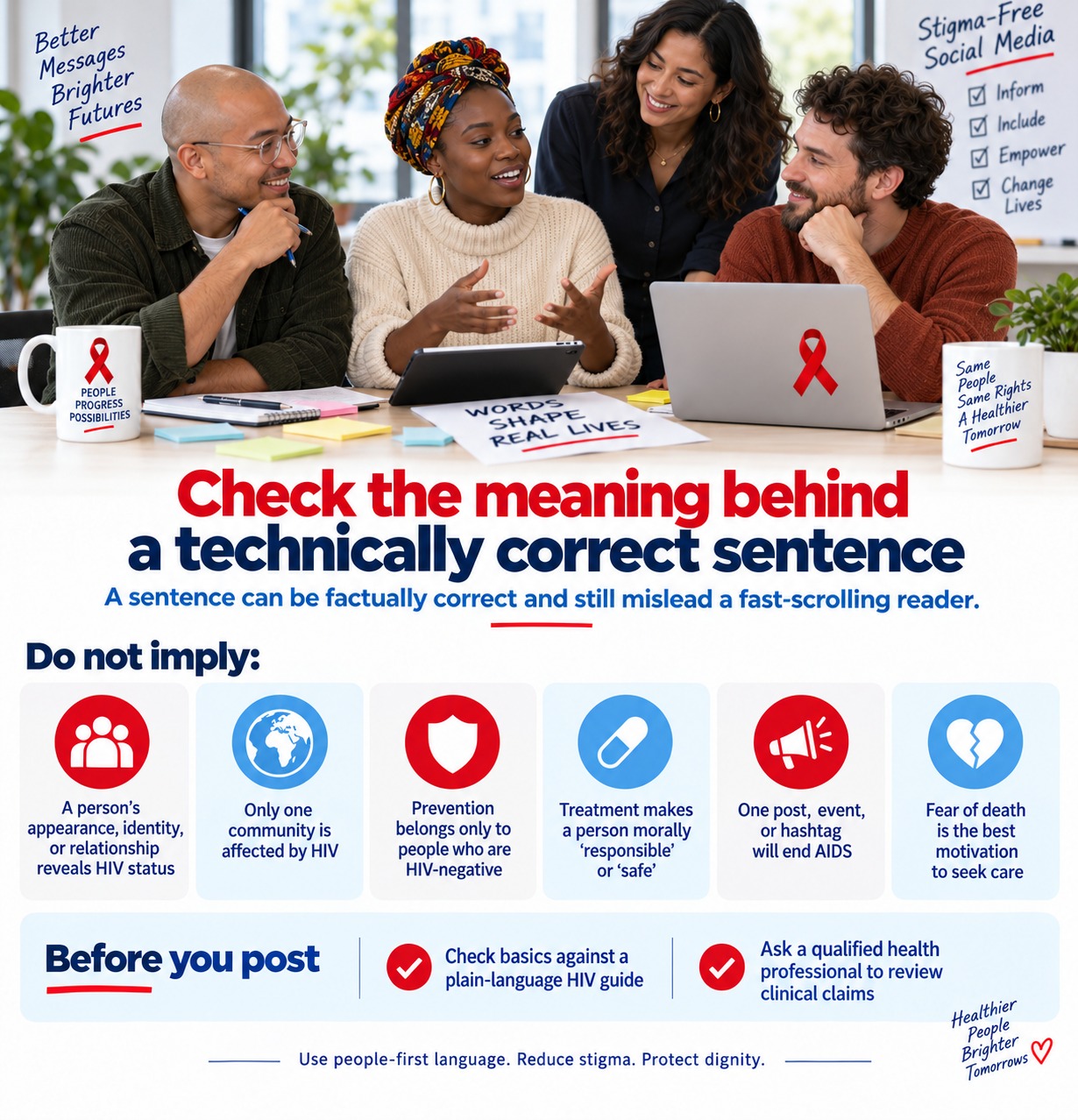
Check the meaning behind a technically correct sentence
A sentence may be factually defensible and still mislead. Review what a fast-scrolling reader could infer. Do not imply that:
- a person's appearance, identity or relationship reveals HIV status;
- only one community is affected by HIV;
- prevention belongs only to people who are HIV-negative;
- treatment makes a person morally “responsible” or “safe”;
- a single post, event or hashtag will end AIDS;
- fear of death is the best motivation to seek care.
Before writing about transmission, testing or treatment, check the basics against a plain-language reference such as Love Foundation's guide to HIV basics, and ask a qualified health professional to check any clinical claim before you post.
Separate awareness from medical advice
Social posts should not diagnose a person, choose a test or recommend an individualized regimen. Use them to explain the next appropriate action and link to a service or authoritative resource.
Want to plan an HIV test? A service provider can help you choose an option based on timing and your situation. Compare locations and contact the clinic before your visit.
For Thailand, a call to action may link to Love2Test, a service-navigation website run by Love Foundation. Confirm the exact destination, language, eligibility information, cost and opening hours before publication. Do not promise that every listed service is free or immediately available.
Obtain specific consent for stories, names and images
Public storytelling can create lasting exposure. A person should understand:
- where the content will appear and whether paid promotion will expand its audience;
- which name, face, voice and health details will be included;
- whether the content may be translated, edited or reused;
- how long it will remain online and how to request withdrawal;
- what the organization cannot remove after others share it.
Consent to attend an event is not consent to be photographed. Consent to a photo is not consent to disclose HIV status. Offer alternatives: an anonymous quote, an illustration, audio without a name or no story at all. Never make access to services or community participation conditional on public disclosure.
Choose visuals that do not stereotype HIV
Avoid relying only on red ribbons, medication bottles, blood, hospital beds, distressed faces or images of one identity group. Match the visual to the action: a phone or map for service navigation, collaboration for solidarity, clear typography for language education. Never caption an unrelated person's photo in a way that implies they have HIV.
Make every asset accessible
- write concise alt text that communicates the image's purpose;
- caption spoken video and review automatic captions;
- place essential information in the post copy, not only inside an image;
- use sufficient color contrast and readable type;
- avoid flashing or rapid transitions;
- explain abbreviations such as ART, PrEP, PEP and U=U;
- test the destination on a phone.
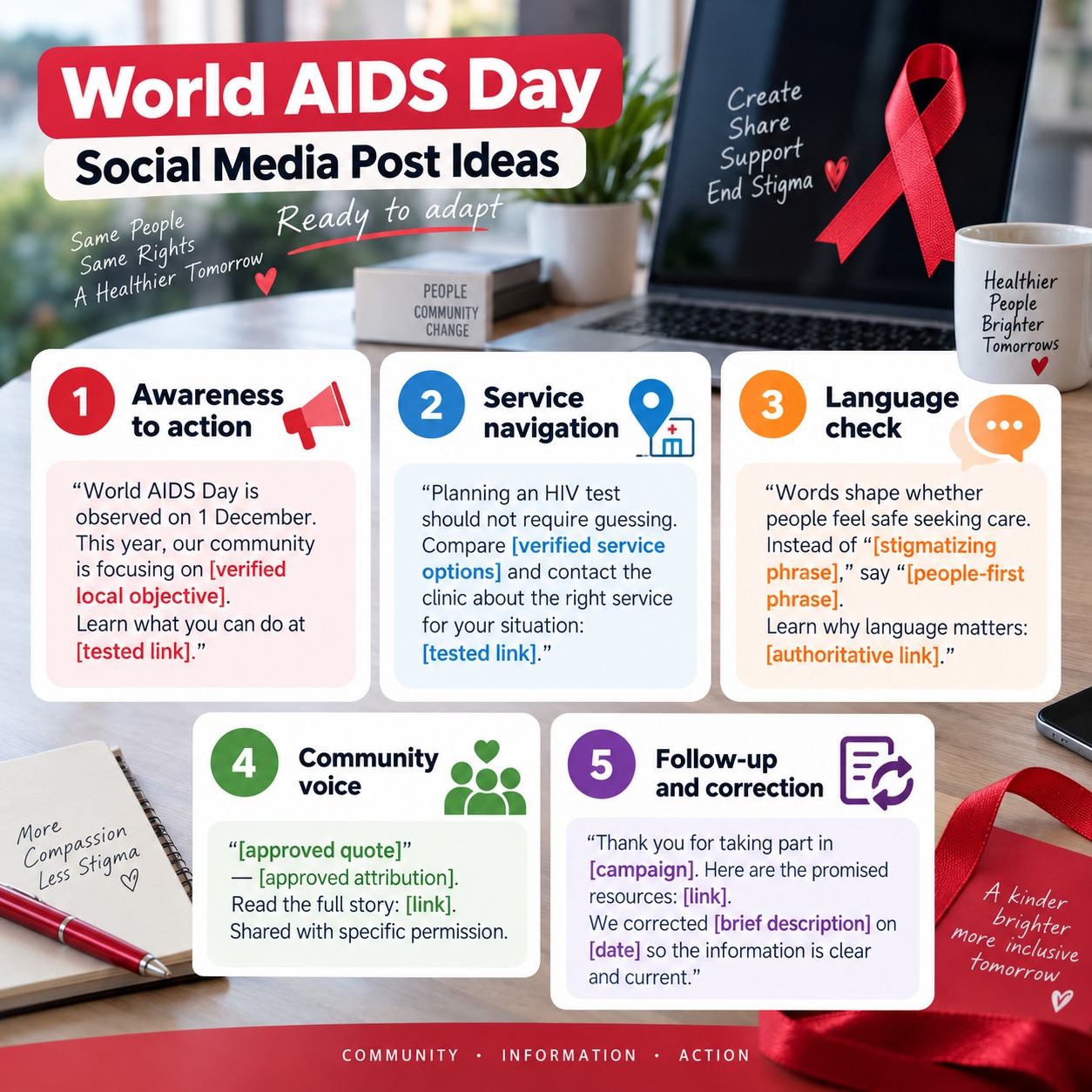
Ready-to-adapt World AIDS Day captions and post structures
These are structures, not universal claims. Replace brackets, verify the final facts and have a qualified health professional check any clinical claim before you post.
1. Awareness to action
World AIDS Day is observed on 1 December. This year, our community is focusing on [verified local objective]. Learn what you can do at [tested link].
2. Service navigation
Planning an HIV test should not require guessing. Compare [verified service options] and contact the clinic about the right service for your situation: [tested link].
3. Language check
Words shape whether people feel safe seeking care. Instead of “[stigmatizing phrase],” say “[people-first phrase].” Learn why language matters: [authoritative link].
4. Community voice
“[approved quote]” — [approved attribution]. Read the full story: [link]. Shared with specific permission.
5. Follow-up and correction
Thank you for taking part in [campaign]. Here are the promised resources: [link]. We corrected [brief description] on [date] so the information is clear and current.
Review the post with four separate passes
- Facts: Is every statistic dated and sourced, and does the wording match the source rather than overstate it?
- Stigma: Is the person described before the condition, without blame or stereotypes? Has a community reviewer checked tone?
- Consent and privacy: Is every name, face, quote and health detail approved for this use? Could a tag or background detail reveal something unintentionally?
- Accessibility and action: Are alt text and captions complete, and does the link open the intended page?
Record who completed each pass and when. “Approved by the team” is not useful when a correction is needed later.
Create a moderation plan before publishing
A campaign account needs a clear response plan. Define who monitors each channel and when, which questions receive a standard resource response, which clinical questions are referred to a provider, and when harassment, threats or forced disclosure is hidden, removed or escalated.
Never confirm or speculate about a person's HIV status in a comment. Move personal health questions to a private route, and warn users not to post identifying details.
Correct mistakes visibly and measure real action
Deleting a post without explanation can leave the incorrect version in screenshots. Pause related scheduled content, correct the original where possible, publish a clear correction when the error was material, and contact anyone whose privacy was affected. State what changed rather than posting a vague apology.
Choose measures that match the message map: clicks to a verified service, registrations, questions answered, misinformation corrected and feedback from the intended community. Likes and impressions describe exposure; they do not prove reduced stigma or testing. Never ask followers to reveal a diagnosis publicly to count participation.
Summary
The best World AIDS Day social content is accurate, respectful, accessible and connected to a useful next action. Start with a message map, verify the current theme, review language and clinical meaning separately, obtain specific consent, test every link and prepare to moderate and correct. Use the templates as structures, not shortcuts.
This article provides communication-planning information. It does not replace individualized medical advice, legal advice or a safeguarding assessment. Confirm health claims and service details with a qualified reviewer and a current source before you post.