A useful World AIDS Day campaign checklist begins with one decision: what should people be able to do after the campaign that they could not do before? The answer might be finding a confidential HIV service, joining a community discussion, requesting a workplace policy review or learning how to support people with HIV. Choose one primary action, build the event around it and decide how you will know whether it happened.
World AIDS Day is observed on 1 December. The World Health Organization's World AIDS Day page describes it as a moment for awareness, international solidarity, remembrance and progress across HIV prevention, treatment and care. That broad purpose is the starting point—not a complete event plan. Organizers still need community leadership, accurate information, privacy safeguards, an accessible format, a working referral route and a realistic evaluation method.
This guide owns that planning intent. It does not replace the official theme page, clinical guidance or an HIV-testing protocol.
The 12-point World AIDS Day campaign checklist
Use this list at the first planning meeting and again at the final go/no-go review.
- Write one primary objective and one audience action.
- Verify the current official theme and permitted campaign assets.
- Invite affected communities into paid or properly supported decision-making roles.
- Define the audience without stereotyping or treating one group as “the problem.”
- Choose a format that matches the objective, venue and available team.
- Confirm every HIV fact, service detail and date with a current source.
- Build consent, confidentiality and safeguarding into the event design.
- Make the venue and materials accessible online and offline.
- Give every call to action a working destination or named owner.
- Assign roles, escalation routes and a simple run-of-show.
- Decide what data you need—and what private data you should not collect.
- Schedule follow-up, evaluation and correction after the event.
Checking every box is not a guarantee of impact. It is a way to expose gaps early, while there is still time to change the campaign.
1. Define an outcome before choosing activities
“Raise awareness” is too broad to guide a budget or measure a result. Translate it into a change that can be observed.
Examples of stronger objectives include:
- help university students locate a confidential testing service;
- equip managers to respond to HIV-related discrimination at work;
- connect community members with prevention, treatment or support navigation;
- recruit local partners for a follow-up health session;
- help participants replace stigmatizing phrases with people-first language.
Then write one audience action. For example: “After the session, participants can scan a tested link and find a suitable service,” or “After the workshop, supervisors can name the process for reporting discrimination.”
Do not promise an outcome the event cannot produce. A one-hour talk may increase access to information; it cannot demonstrate that HIV incidence has changed.
2. Verify the current theme instead of recycling last year's message
Annual World AIDS Day themes and assets can change. Before printing a banner or scheduling posts:
- check the current page from WHO or the organization whose asset you plan to use;
- confirm the year shown on the asset;
- read any logo, image-credit and adaptation requirements;
- record the source URL and the date your team checked it;
- recheck immediately before publication.
If the current official theme has not been released, build the operational plan with a placeholder. Do not label an old theme as current and do not invent a future theme for search traffic.
3. Put communities in the planning room
A campaign about people is weaker than a campaign made with them. Involve people with HIV and communities affected by HIV when setting the goal, choosing language, selecting speakers and reviewing the final experience.
Participation should be meaningful. Explain how decisions will be made, what can still change, how feedback will be used and whether compensation or expenses are available. Do not ask someone to disclose a diagnosis in order to prove that their perspective is valid.
A small planning group can include:
- a community representative or peer leader;
- a clinical or public-health reviewer;
- a safeguarding contact;
- an accessibility reviewer;
- a service-navigation partner;
- a communications lead;
- the person responsible for evaluation and follow-up.
One person may cover more than one role in a small event, but the responsibilities should still be explicit.
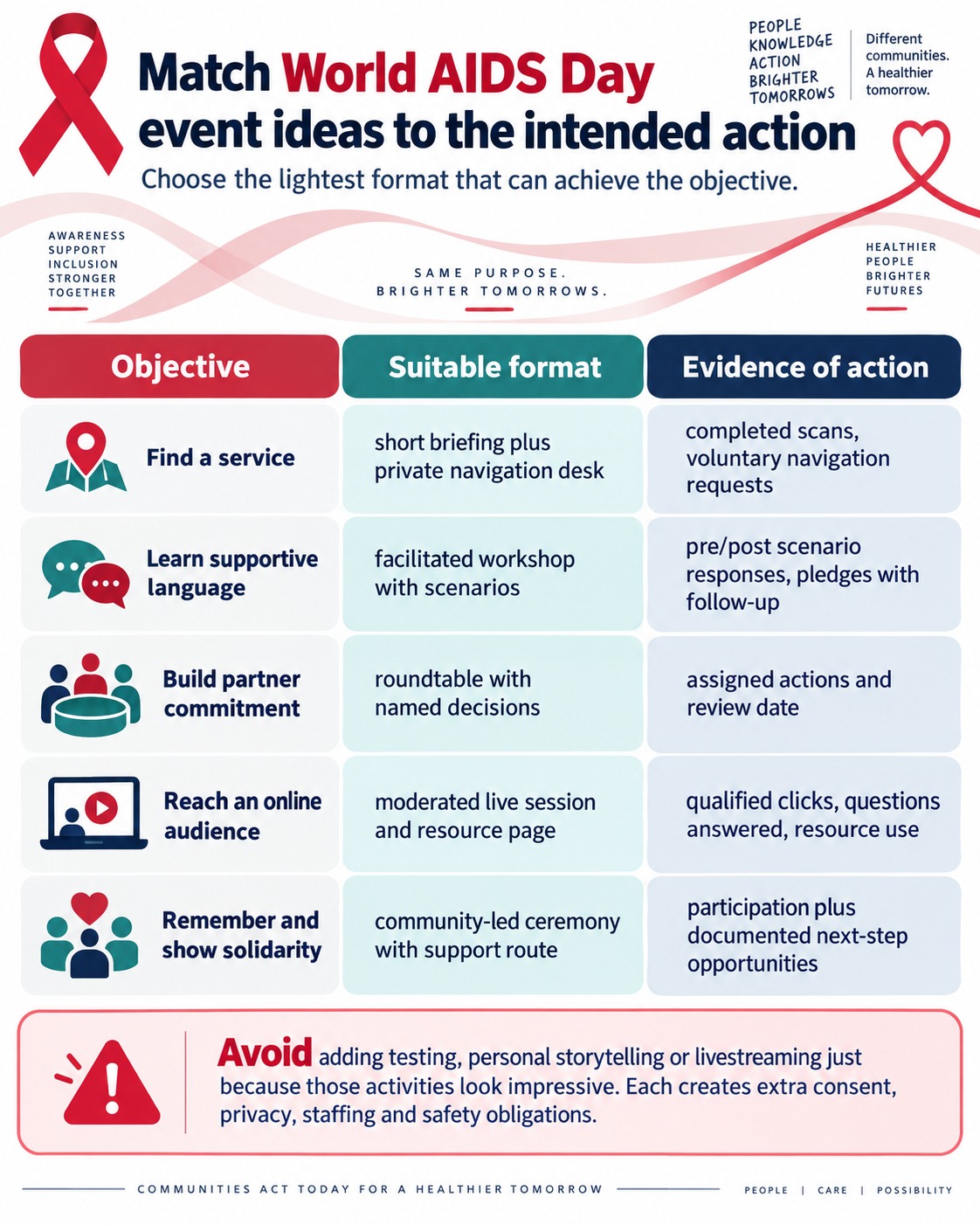
4. Match World AIDS Day event ideas to the intended action
Choose the lightest format that can achieve the objective.
| Objective | Suitable format | Evidence of action |
|---|---|---|
| Find a service | short briefing plus private navigation desk | completed scans, voluntary navigation requests |
| Learn supportive language | facilitated workshop with scenarios | pre/post scenario responses, pledges with follow-up |
| Build partner commitment | roundtable with named decisions | assigned actions and review date |
| Reach an online audience | moderated live session and resource page | qualified clicks, questions answered, resource use |
| Remember and show solidarity | community-led ceremony with support route | participation plus documented next-step opportunities |
Avoid adding testing, personal storytelling or livestreaming just because those activities look impressive. Each creates extra consent, privacy, staffing and safety obligations.
5. Make the call to action usable
Every campaign should answer “What can I do now?” A useful call to action has a verb, a destination and an expectation.
Weak: “Get tested.”
Stronger: “Use the service finder to compare locations and contact the clinic to confirm eligibility, cost, opening hours and the right test for your situation.”
For Thailand service navigation, organizers can direct people to Love2Test, a partner service-navigation website operated within our network. Test the exact page on a phone, confirm that the destination still works and avoid promising that every service is free or available to every person. Eligibility and appointments can vary by location.
If the campaign refers people to prevention, treatment, mental-health, legal or emergency support, assign someone to verify each route. A QR code is not a referral plan if nobody checks where it goes.
6. Treat testing as a health service, not an event prop
An awareness event does not become a safe testing service by adding rapid tests. Testing requires trained providers, an appropriate testing strategy, quality assurance, privacy, counselling or information, and connection to follow-up services.
WHO's HIV testing services guidance describes five essential principles: consent, confidentiality, counselling, correct results and connection to prevention, care and treatment. Apply them to any testing component from the start.
At minimum:
- participation must be voluntary;
- nobody should be tested publicly or pressured by an employer, school, partner or organizer;
- result conversations need an acoustically and visually private space;
- screening results must be explained correctly, including the route for confirmatory testing when needed;
- the team must know where a participant can go next;
- event photos, attendance records and testing records must remain separate.
Do not count or announce individual results. If anonymized service totals are needed for evaluation, agree the method with the clinical provider before the event.
7. Build consent and safeguarding into the design
Consent is a process, not a single release form. A person may agree to attend but not to be photographed. A speaker may agree to share a story in the room but not on a livestream. A volunteer may agree to be named but not have their health information discussed.
Create separate choices for:
- event registration;
- photography and video;
- livestreaming or recording;
- use of a quote or personal story;
- contact after the event;
- optional evaluation questions.
Tell people how to withdraw permission and who to contact. Avoid colored badges or seating arrangements that accidentally reveal a person's HIV status or service choice.
Name a safeguarding lead and a private route for reporting harassment, forced disclosure, discriminatory comments or unwanted contact. Brief moderators and volunteers on what to do; do not leave them to improvise during a crisis.
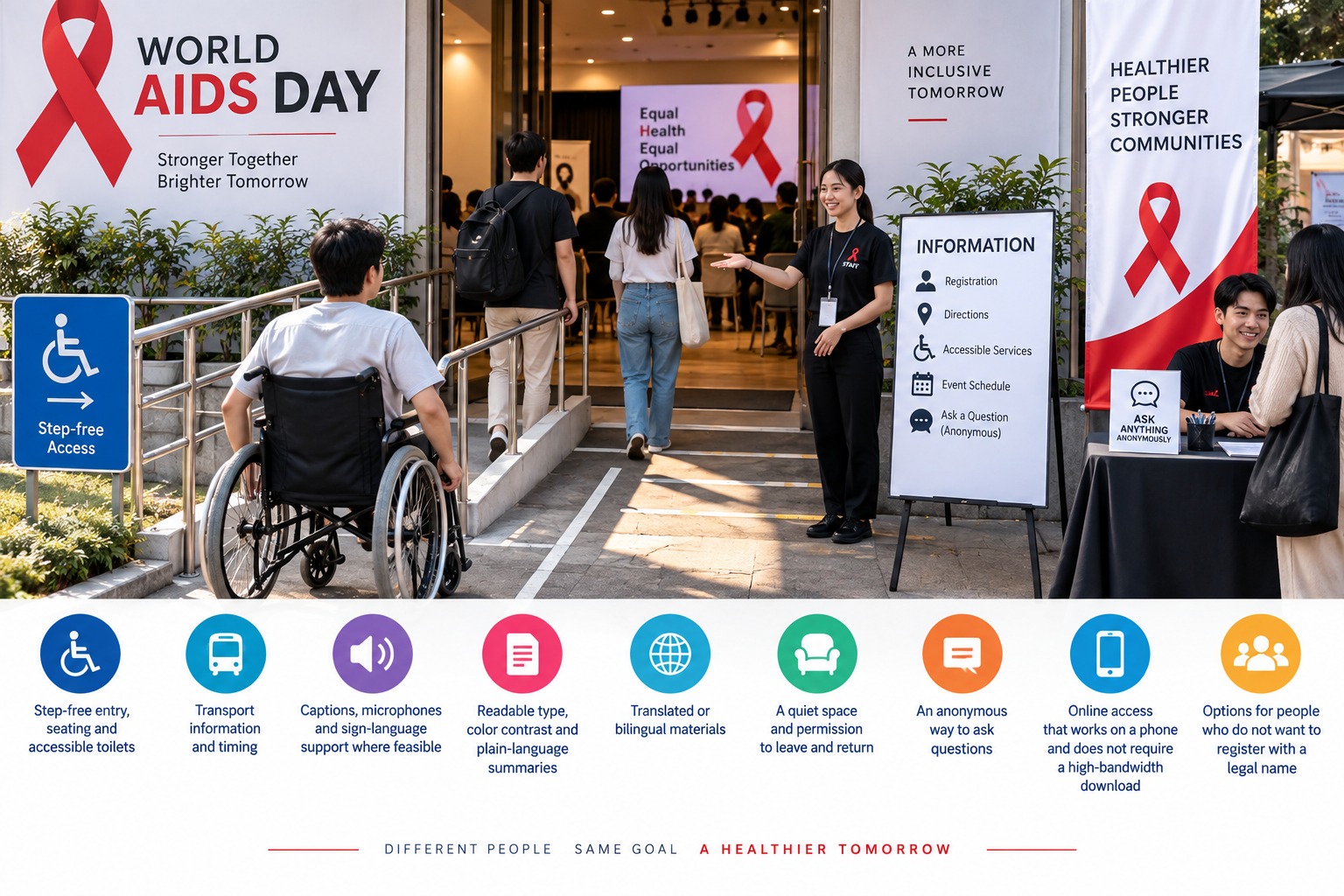
8. Design for access, not only attendance
Accessibility includes physical, sensory, language, digital, financial and social access. Review:
- step-free entry, seating and accessible toilets;
- transport information and timing;
- captions, microphones and sign-language support where feasible;
- readable type, color contrast and plain-language summaries;
- translated or bilingual materials for the intended audience;
- a quiet space and permission to leave and return;
- an anonymous way to ask questions;
- online access that works on a phone and does not require a high-bandwidth download;
- options for people who do not want to register with a legal name.
Do not describe a campaign as inclusive based only on the diversity of its poster. Inclusion must be visible in who makes decisions and how people can participate safely.
9. Review facts, language and speaker claims
Create a source sheet for every health claim. Record the exact wording, source, review date and reviewer. Separate:
- clinical facts that require medical review;
- service details that require local verification;
- annual campaign language that requires a current official source;
- personal experience that should not be presented as universal evidence.
Use people-first language and avoid fear-based claims. Do not use appearance, relationship status, gender, occupation or identity as a shortcut for HIV status. If a speaker plans to discuss testing, treatment or prevention, review the slides before the event and agree how the moderator will correct an inaccurate statement without humiliating the speaker.
10. Give the team a run-of-show and an escalation map
A simple run-of-show prevents many avoidable problems. Include:
- time and activity;
- lead person and backup;
- equipment or material needed;
- accessibility action;
- consent check;
- service call to action;
- contingency if the activity runs late or a speaker cancels.
Create a separate escalation map for a medical question, a distressed participant, harassment, misinformation, media attention and a privacy incident. The answer is not always “send it to the organizer.” Name the person with the relevant responsibility.
11. Plan communications as a workstream
Campaign promotion should use the same facts, consent rules and service routes as the event. Prepare the message map, approved terminology, asset list, alt text, moderation rules and correction process before the first post is scheduled.
Use the separate World AIDS Day social media toolkit for that production workflow. Keeping the social toolkit separate prevents the event checklist from becoming a collection of captions and protects the distinct search intent of both pages.
12. Base HIV campaign evaluation on action, not unnecessary data
Start with the objective and choose the minimum data needed. Possible measures include:
- number of people who reached a verified service page;
- requests for private navigation or follow-up;
- resources downloaded or collected;
- questions answered and themes requiring a later resource;
- partner actions completed by an agreed date;
- improvement on an anonymous knowledge or language scenario;
- accessibility requests fulfilled;
- corrections or safeguarding incidents and how they were resolved.
Reach and impressions can describe distribution, but they do not prove knowledge, service access or behavior change. The CDC social marketing toolkit emphasizes strategy, audience-appropriate materials and evaluation across the campaign process.
Avoid collecting names, diagnoses, test results or contact details just because a form makes it easy. Explain why each field is needed, restrict access and set a deletion date.
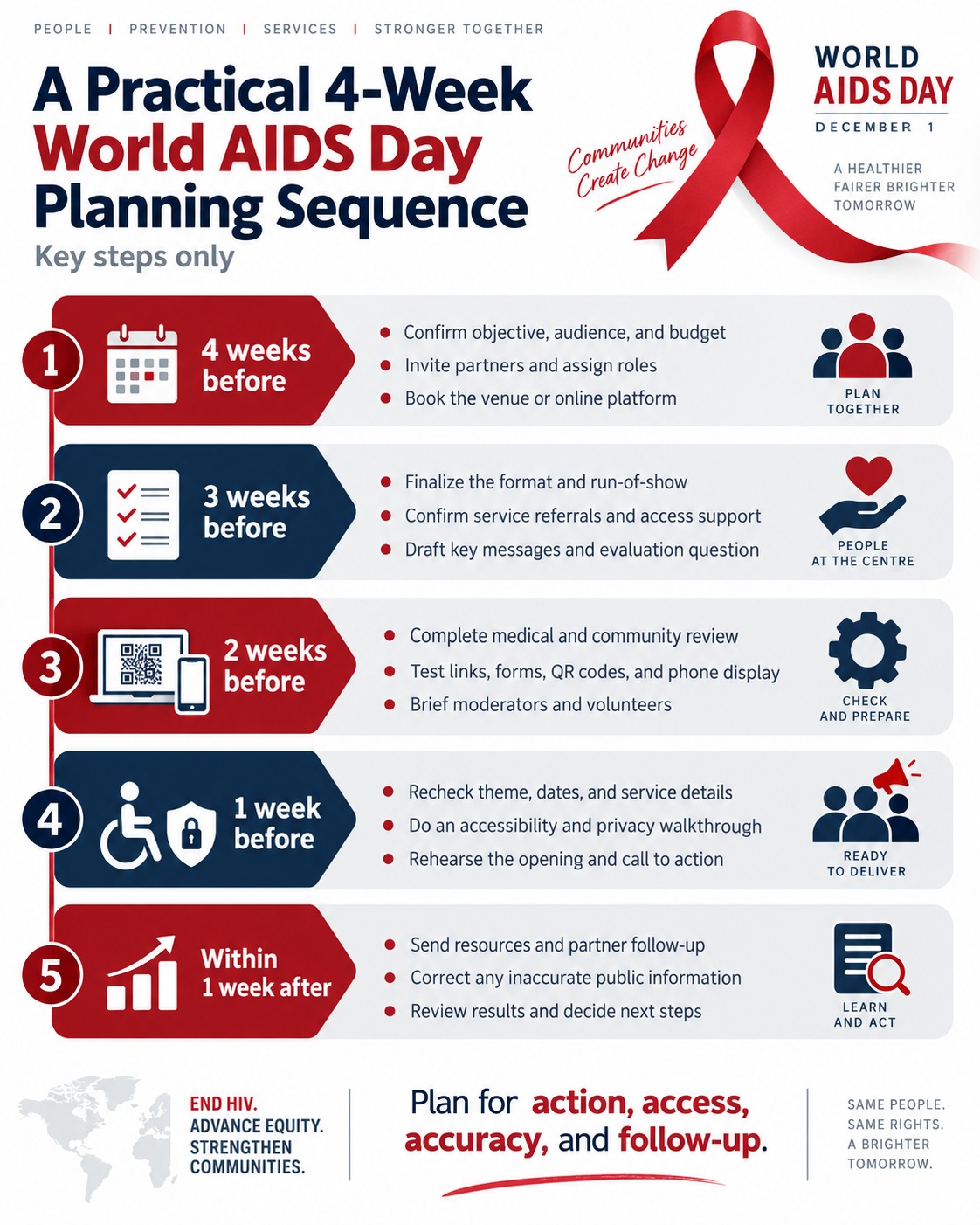
A practical four-week World AIDS Day event planning sequence
Four weeks before
- confirm the objective, audience and budget;
- invite community partners and assign responsibilities;
- reserve the venue or platform;
- identify the medical, safeguarding and accessibility reviewers;
- verify the official campaign source and provisional theme assets.
Three weeks before
- agree the format and run-of-show;
- confirm service-navigation destinations;
- draft health claims, speaker guidance and consent choices;
- plan access support and translations;
- define the evaluation question.
Two weeks before
- complete medical and community review;
- test links, forms, QR codes and phone display;
- brief moderators and volunteers;
- confirm photography, story and media boundaries;
- prepare contingency routes.
One week before
- recheck the current theme, dates and service details;
- run an accessibility and privacy walkthrough;
- rehearse the opening, call to action and difficult-question process;
- schedule approved communications;
- prepare a correction contact and follow-up owner.
Within one week after
- send promised resources and partner actions;
- correct any inaccurate public material;
- review anonymized indicators against the objective;
- document safeguarding and access lessons;
- decide what continues beyond 1 December.
Common campaign failures to catch early
Pause and revise if the plan depends on any of these:
- an unverified annual theme;
- fear, blame or “clean/dirty” language;
- a surprise request for someone to disclose their status;
- filming by default with no practical opt-out;
- testing without privacy and a confirmatory pathway;
- a QR code that leads to a generic home page rather than a usable next step;
- a target based only on likes or attendance;
- a story about a person with HIV that they did not review or approve;
- a claim that one campaign will “end AIDS” without specifying its contribution;
- no owner for follow-up after the event.
Final go/no-go review
The campaign is ready when the team can answer yes to five questions:
- Is the objective specific enough to evaluate?
- Did affected communities influence the final decisions?
- Are health claims, annual assets and service routes current?
- Can people participate without unwanted disclosure, coercion or inaccessible barriers?
- Is there an owner and deadline for every action promised after the event?
If any answer is no, moving the launch date is safer than publishing a campaign that may misinform, expose or disappoint the people it intends to support.
Summary
A strong World AIDS Day campaign does more than make HIV visible for one day. It gives a defined audience a credible next step, protects consent and confidentiality, connects awareness to usable services and leaves the team with evidence it can use to improve.
Use the checklist as a decision tool, not a decoration. Verify the current official theme, involve communities early, separate an awareness event from clinical testing, assign real owners and measure meaningful action rather than impressions alone.
This article provides campaign-planning information. It does not replace clinical protocols, individualized medical advice, legal advice or a safeguarding assessment. Confirm health claims and service details with a qualified reviewer and a current source before you publish your own campaign materials.